

Very little of this post is original work, and most of it will already be familiar to the rationalist community. This is a signal-boost of important insights made by others.
Summary: You can use light to improve mood in the winter very effectively, but knowledge of how to do it isn’t well dispersed. Do not get a “SAD lamp” or a “light therapy lamp” or other such branded product. There is nothing special about those lamps, and they probably won’t work. What matters is getting lots of light into your eye cones - much more than a typical SAD lamp can provide. You can do this cheaply and beautifully by filling your house with powerful lightbulbs in a color tone of your choosing.
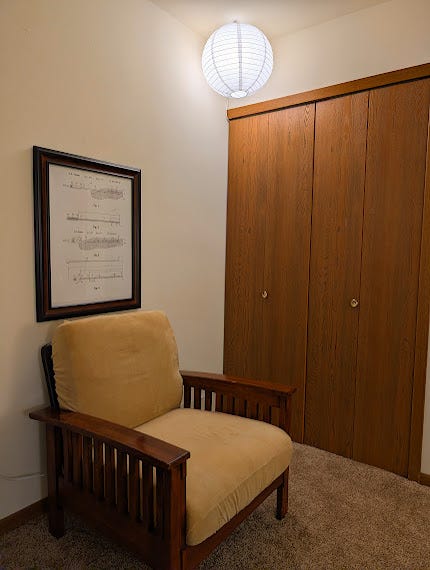
Right now my house is absolutely full of bright, gorgeous warm light. I absolutely love it, and when I travel I find myself craving it. It treats seasonal depression very effectively, and it also makes nearly everyone feel more uplifted and energized as soon as they come in contact with it. In the rationalist community, due to the efforts of a handful of good writers and scientists, lighting your home this way is almost standard practice. (You can often tell which one is the rationalist house without looking at street numbers, because it’s shining like the sun.)
But tons of people don’t know about this. Especially now that it’s winter in Wisconsin, it makes me really sad when I notice how dark and depressing many indoor places are, because I feel really bad for all the people white-knuckling unnecessary seasonal depression or wasting money on SAD lamps.
Smarter people than me have written extensively about this, so here are some quotes from these two great summary articles (Part 1, Part 2), lightly edited for conciseness. If you only read one other post on this topic, I recommend Part 1.
The amount of light delivered in the scientific studies is only barely enough to be effective. Most of the “SAD lights” people buy give much less light even that that. People try them and conclude “didn’t work for me”—but those things probably wouldn’t work for anyone.
The light dose delivered by most light therapy lamps is less than a tenth of what the medical science recommends.
Light therapy lamps are just ordinary lights; there’s nothing special about them.
Many advertise themselves as “UV-free.” This is effectively meaningless. LEDs don’t emit any UV, so this is like advertising orange juice as “gluten-free.”
Many SAD lights advertise themselves as “full-spectrum.” [This] is meant to suggest that the light emitted is similar to daylight—but that is actually false.
I recommended against buying anything sold as a “light therapy lamp” or “SAD lamp” or “light box.”
[Instead, he recommends buying high quality bright lightbulbs.] You will probably find that using them makes you markedly more cheerful and productive. This may take effect rapidly, possibly even within minutes of first use, although the usual story is that you need to use a SAD light for a couple weeks to get relief. (Maybe that’s because they are badly underpowered?)
So what do you do? Here are my notes and recommendations.
Specs You Care About
- Lumens, not lux: “Any light bulb can be 10,000 lux if you put it next to your eyeball. What we really need to know is the total lumens.”1 Buy HIGH LUMEN lightbulbs. This is the main thing that matters.
- Color Rendering Index (CRI): A measure of how accurately your lights reflect the colors of objects. This might matter to you, particularly if you want cool-toned lights. People often feel depressed in artifical cool light even when it is high lumen, which is surprising, given that people usually feel great under the sun (which is also cool-toned)! This might be due to cool lightbulbs having bad CRI. You can probably avoid having to think about this by getting warmer toned lights.
- Temperature: Largely a matter of personal preference. Cooler lights are more energizing for some people, but this matters less than lumen count. 6000K lights mimic the color of sunlight and look cool. 3000K lights look warm. Some folks recommend less than 3000K for evening to help you wind down, but that’s not required. I use 3000K bulbs throughout my whole house all the way up until bedtime, and just turn a couple off when I want to wind down.
Recommendations
I use these. I absolutely love them. (I am not getting paid to say this.) At five thousand lumens, they are more than 6 times as bright as a standard lightbulb, and my whole house is bathed in warm faux-sunlight.
They’re warm-toned (3000K). They are still extremely energizing, and personally I find the warm tone more beautiful. (This way I also avoid worrying about CRI and people potentially having a bad reaction to cool light.) I get lots of compliments - I have been told that my house is “as bright as a department store but somehow nice, not glaring.”
You can use a lot of them. I have four in my office and three in the bathroom, plus a handful scattered over the main living areas. Many people with treatment-resistant seasonal depression improved dramatically by just adding LOTS MORE LIGHT than recommended.2 Your eyes adjust to different environments, so most people don’t realize how much darker indoor environments are than outdoor environments. Try adding more light than you think you need, and see how it makes you feel. Most people end up loving it.
I put lots in the bathroom because light is most important in the first few hours of the morning. I have a clear shower curtain so I get lots of light while I shower and get ready for work.
Buy one and see if you can swap it into a light fixture you already own! They have a standard base, so many built-in light fixtures will support them.
However, many shades for tabletop lamps won’t fit over the wide head of the bulb. I’ve solved this problem with these paper lanterns.3


I pop them over tabletop lamps, and I also rig them up on hanging cables4 at various heights around the room, so that as many of my eye cones are getting hit with those delicious photons as possible, no matter which way I’m looking.
There you go! Any questions? Please let me know how it goes if you try it.
Great posts that contributed to this body of knowledge include:
Inadequacy and Modesty part iv
(One of the great classic accounts of figuring this out first-hand)
How to Build a Lumenator
(One of the early how-to posts)
Guide to Rationalist Interior Decorating
(Covers the lighting need-to-knows and lots of other helpful tips)
Why indoor lighting is hard to get right and how to fix it
(An in-depth practical summary)
How to use bright light to improve your life.
(Covers lots of details about timing and color)
100,000 lumens to treat seasonal affective disorder
(A published randomized controlled trial inspired by the work of multiple folks mentioned above)
Inadequacy and Modesty (part iv)